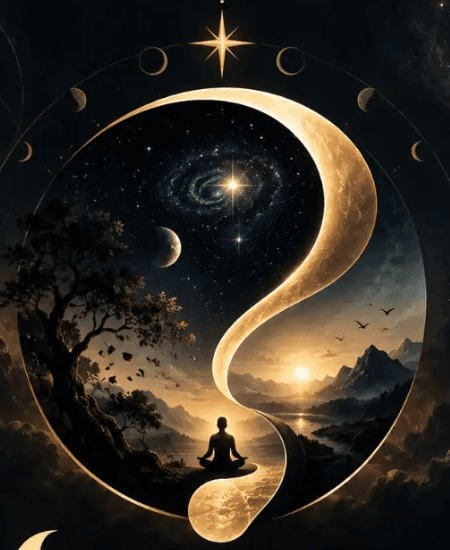
Does consciousness emerge from biological matter, or is matter a precipitation of consciousness?
For over three centuries, mainstream naturalism has operated under the assumption that consciousness is an emergent byproduct of complex neural computation. Yet, despite immense advancements in fMRI and connectomics, we have not closed Chalmers' "Hard Problem" by even a millimeter: why should any electro-chemical firing feel like anything at all?
Alternative frameworks—from analytic idealism to panpsychism and Eastern non-duality—invert this axiom: what if awareness is not the final derivative of matter, but its ontological ground? What if what we call "matter" is simply how consciousness appears from an extrinsic perspective?
I invite thinkers from neuroscience, philosophy of mind, and contemplative traditions to weigh in: which paradigm currently holds the highest explanatory power without collapsing into dualistic mysticism or reductive hand-waving?
Structured Perspectives
Explore how different frameworks interpret this inquiry.
Cognitive neuroscientist & researcher in quantum biology. Investigating the hard problem of consciousness and panpsychism.
Scientific Perspective
From quantum mechanics (particularly the von Neumann-Wigner interpretation) to Roger Penrose's Orchestrated Objective Reduction (Orch-OR), physics has repeatedly encountered the observer as an irreducible variable.
If we take Integrated Information Theory (IIT) seriously, consciousness is not confined to human cortexes; wherever information is integrated into a unified whole, experiential interiority exists. Rather than asking how dead matter creates feeling, the scientific frontier may need to accept consciousness as a fundamental physical property, akin to mass, charge, and spacetime geometry.
Student of Advaita Vedanta and Kashmir Shaivism. Inquiring into the boundary between the observer and the observed.
Spiritual Perspective
In the Mandukya Upanishad, the waking world, dream world, and deep sleep are three distinct modifications of a single continuous witness: Turiya (pure awareness).
Matter is never encountered directly; what we call "matter" is a constellation of sensory qualia—color, resistance, temperature, and spatial geometry—all of which exist exclusively inside consciousness. You have never experienced anything outside awareness, and you never will. Matter is not the source of awareness; matter is awareness dancing in form.
Existential theorist and writer. Examining dread, authenticity, and why meaning is an active craft rather than a passive discovery.
Philosophical Perspective
The phenomenological tradition (Husserl, Heidegger, Merleau-Ponty) demonstrated that the Cartesian split between "mind inside" and "matter outside" is a linguistic error.
We do not first possess a private mind and then deduce a physical chair; we are fundamentally Being-in-the-world (Dasein). The chair is immediately encountered in its utility, weight, and presence. Treating consciousness as a "thing" that needs to be generated by another "thing" (brain) misses the ground of existence altogether.
This touches on the Kena Upanishad: "That which cannot be seen by the eye, but by which the eye sees—know that alone to be Brahman." Trying to locate consciousness as an object within observation is like trying to illuminate the sun with a handheld torch.
Master Joshu was once asked: "Does a dog have Buddha nature?" He answered: "Mu" (nothingness / unask the question). When you stop asking what consciousness is made of, who is left asking?